Lead Paint Found.
Handle It Right.
Lead paint in older structures requires licensed abatement coordination before any sanding, demolition, or major renovation work can proceed safely.
What We Do
Licensed Coordination. Full Compliance.
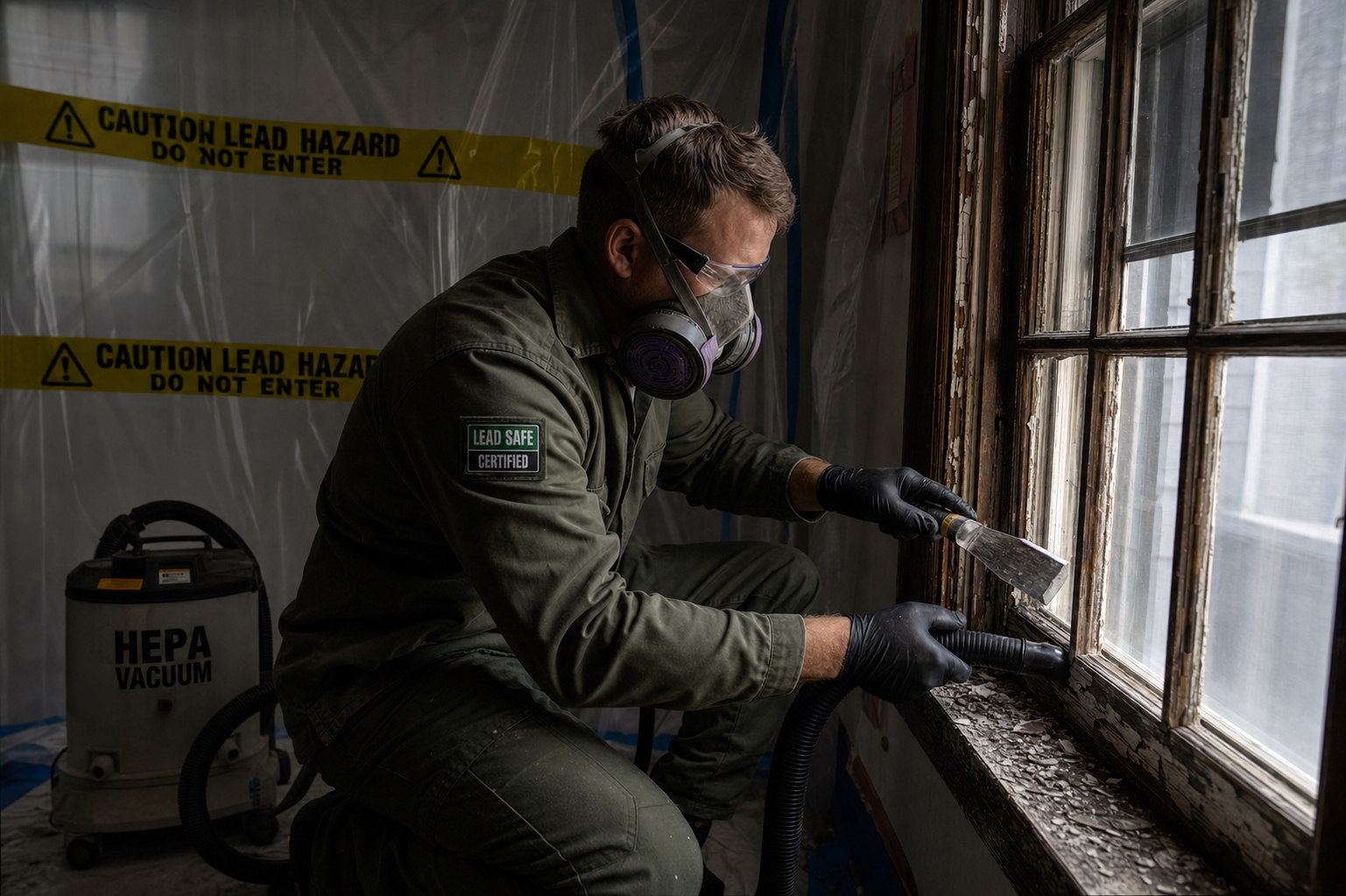
Lead-based paint was commonly used in residential and commercial structures built before 1978, and it remains a significant health hazard — particularly for children under six and pregnant women — when it deteriorates, is disturbed by renovation, or is damaged by fire, water, or storm events. Cantt Restoration coordinates licensed lead paint abatement in full compliance with EPA RRP (Renovation, Repair, and Painting) rules and applicable state regulations, integrating the abatement scope into your broader restoration timeline without delays.
All lead paint abatement work is performed by licensed, EPA-certified abatement contractors. Cantt Restoration manages the full coordination — one call covers everything from initial testing through final clearance. Licensed subcontractor credentials are available on request.
Lead Testing Coordination
We coordinate XRF testing or paint chip sampling by qualified professionals to determine the presence and location of lead-based paint before any disturbance occurs.
Licensed Abatement Contractor Management
Physical abatement is performed by licensed lead abatement contractors we coordinate and manage — Cantt oversees the project from planning through clearance, so you have one point of contact.
EPA RRP Compliance Oversight
We ensure all work in pre-1978 structures follows EPA Renovation, Repair, and Painting Rule requirements, including lead-safe work practices, proper containment, and compliant waste disposal.
Clearance Testing Coordination
We coordinate post-abatement clearance testing by a licensed inspector to confirm all affected areas meet clearance standards before re-occupancy or continued restoration work.
Integration with Restoration Scope
We sequence lead abatement within your overall restoration project — structural drying, reconstruction, and finishing work are scheduled around abatement milestones to minimize total project time.
Complete Documentation Package
All testing reports, contractor certifications, waste manifests, and clearance results are compiled into a single project file for your records and insurance carrier — ready for adjuster review.
Immediate Steps
What You Should Do Right Now
- 1 If you are in a pre-1978 structure and damage or renovation will disturb painted surfaces — stop work immediately. Sanding, cutting, or demolishing lead-painted surfaces without proper containment and protection creates serious health hazards. If you do not feel safe, leave the area.
- 2 Keep children and pregnant women out of areas with deteriorating paint or any area where painted surfaces have been disturbed. Do not clean up paint chips or dust with household vacuums or brooms — this disperses lead dust further.
- 3 Do not attempt lead testing or abatement without licensed professionals. Regulatory requirements govern both activities, and improper handling creates health liability and legal exposure for the property owner.
- 4 Video the affected area before touching anything, then photograph. Document the location and condition of all suspect painted surfaces — this record supports both the abatement scope and any related insurance claim.
- 5 Call Cantt Restoration at (903) 251-9525. We coordinate testing and abatement and integrate it into your restoration project — one call, one point of contact from assessment through clearance.
Insurance & Documentation
How We Document It
Pre-Abatement Testing Records
We compile all XRF results or paint chip analysis reports documenting lead presence, location, and condition in the structure — establishing the foundation for both the abatement scope and the insurance claim.
Compliance & Contractor Documentation
All EPA RRP notifications, contractor certifications, work plans, containment inspections, and waste disposal manifests are maintained in a complete project file and provided to your carrier.
Post-Abatement Clearance Reports
Clearance testing results from a licensed inspector confirm that all abated areas meet federal and state standards — essential documentation for insurance claims and permanent property records.
Why Cantt
Built Different. Independent.
Independent, Not Franchised
We manage lead abatement as a coordinated project — one point of contact from testing through clearance, integrated with your restoration work. You are not managing a testing lab, an abatement contractor, and a restoration company independently.
Insurance Experience From Both Sides
When lead paint abatement is triggered by a covered loss, documentation of that connection is critical for claim approval. Our staff includes former insurance agents and adjusters who know exactly what to capture and how to present it.
Health-First Coordination
We do not rush through regulatory requirements on lead abatement — the health consequences of improper lead disturbance are severe, and we take that seriously on every project. Every clearance milestone is documented before work continues.
What Our Clients Say
Real Results
"Our 1965 home had water damage that required major demo. Cantt identified lead paint in the areas to be demolished, stopped work, and coordinated licensed abatement before we proceeded. That careful approach protected our kids and kept the insurance claim clean."— Michelle P., Whitehouse, TX
"As a commercial property owner with older buildings, I rely on Cantt to flag lead paint issues before they become liabilities. They coordinate everything and the documentation is airtight. Every carrier I have worked with has accepted their reporting without question."— Alan T., Kilgore, TX
Questions
Frequently Asked
My house was built in 1975 — does that mean it definitely has lead paint?
Not necessarily, but the risk is real. Lead-based paint was legal in the U.S. until 1978, so any structure built before that date may contain it. Lead paint in good condition that is not being disturbed presents minimal immediate risk. The hazard arises when paint deteriorates or when renovation, repair, or damage disturbs the painted surface. The only way to confirm whether lead-based paint is present and where is through testing. We coordinate that testing as part of our project process — we do not make assumptions either way based on age alone.
Does insurance cover lead paint abatement costs?
It depends on the policy and the circumstances. When lead paint abatement is required as a direct result of a covered loss event — water damage, fire, or storm damage that disturbs lead-painted surfaces — the abatement cost is often covered as part of that loss. Abatement triggered solely by age or renovation planning is typically not covered. Our former adjuster staff understands how carriers evaluate these determinations and documents the connection between the covered event and the abatement need clearly. We assess on-site, not over the phone, and we help you understand your coverage position before work begins.
Can we continue restoration work in other areas while lead abatement is happening?
In most cases, yes — proper containment allows restoration work to continue in unaffected areas of the structure while abatement proceeds in the contained zones. We sequence the project specifically to minimize total timeline and reduce the period your property is disrupted. We plan the abatement and restoration scopes together so the two workstreams do not conflict and the overall project moves as efficiently as possible.
Ready to Get Started?
Available 24 hours a day, 7 days a week. We respond immediately.
(903) 251-9525