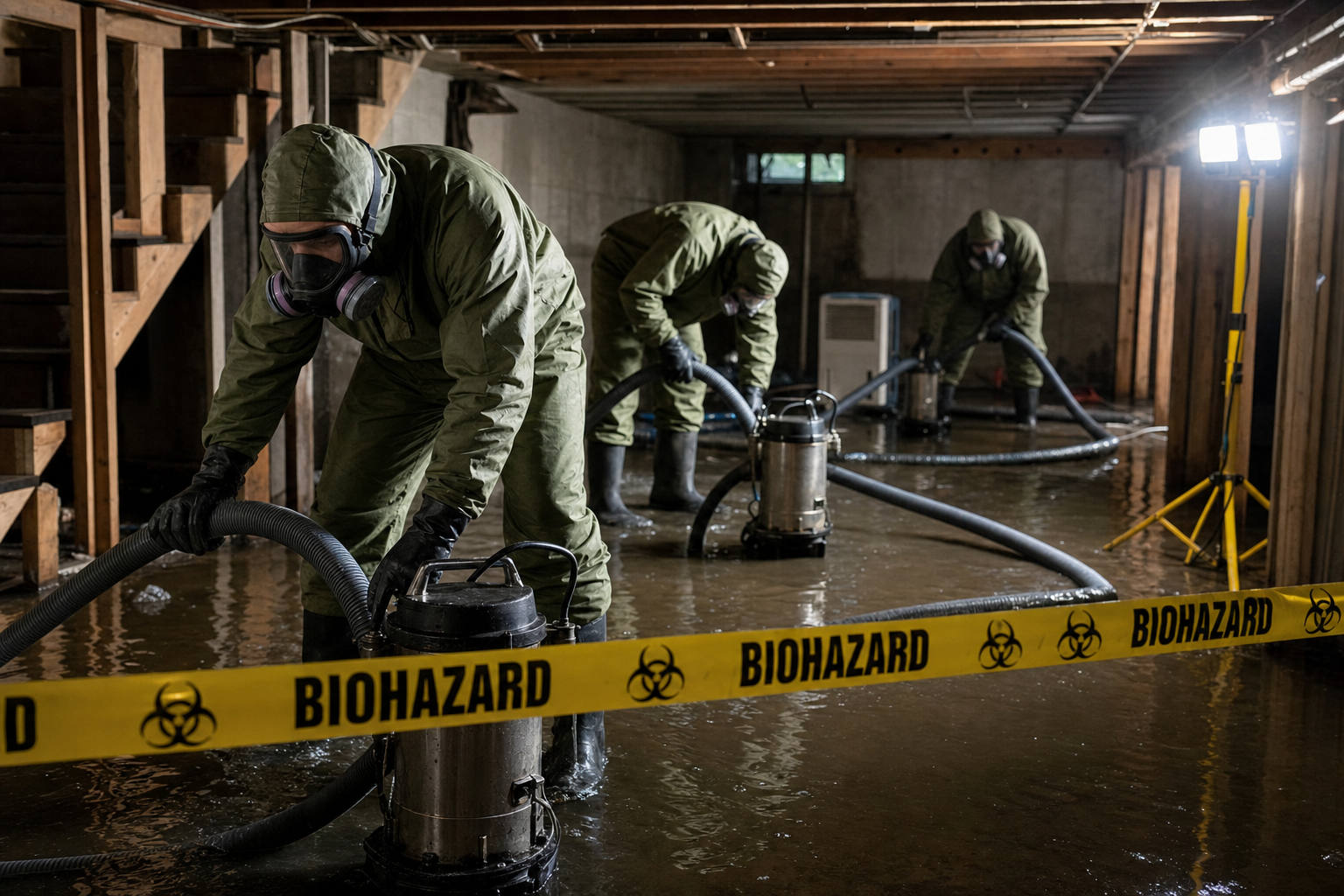
Water In.
We Dry It Out.
Sewage backups and water intrusion require immediate extraction and category-correct drying — delays destroy structures and create serious health hazards.
What We Do
Category-Correct Water Damage Response
Water intrusion is categorized by contamination level, and that category determines everything about how the job is handled. Cantt Restoration responds to all three ANSI/IICRC S500 water damage categories — clean water, gray water, and sewage (Category 3) — with the appropriate PPE, extraction equipment, and drying protocol for each. We do not treat a sewage backup the same as a supply line leak, and that distinction protects your family, your structure, and your insurance claim.
Emergency Extraction
We remove standing water using truck-mounted and portable extraction units — the faster water is removed, the less structural damage and secondary mold risk you face.
Category Assessment & Contamination Control
We identify the water category per ANSI/IICRC S500, establish appropriate containment for Category 2 and 3 losses, and don PPE before contact with any sewage-contaminated materials.
Structural Drying
We place industrial-grade desiccant and refrigerant dehumidifiers alongside high-velocity air movers in a controlled drying system — no household fans on wet materials.
Moisture Monitoring
We take daily psychrometric readings and log structural moisture levels until the structure reaches documented drying goals.
Contaminated Material Removal
Category 3 losses require removal of affected porous materials (flooring, drywall, insulation) — we remove, bag, and properly dispose of all contaminated contents per S500 guidelines.
Content Pack-Out & Restoration
We identify, document, and remove salvageable contents for professional cleaning and restoration at our facility — recovering contents is almost always more cost-effective than replacement.
Immediate Steps
What You Should Do Right Now
- 1 If sewage is involved, do not enter the area without protective gear. Raw sewage is a Category 3 biohazard — exposure carries serious health risks. If you do not feel safe, leave immediately and call us.
- 2 Turn off the water source if it is a supply-side break. Locate your main shutoff and stop the flow before additional water enters the structure.
- 3 Do not run fans or your HVAC system over wet materials. This spreads contamination and disrupts the controlled drying environment we need to establish.
- 4 Video the space before moving anything, then photograph. Capture all affected rooms, walls, flooring, and any visible contents — this footage is essential for your insurance claim. Video beats photos — start there.
Insurance & Documentation
How We Document It
Drying Logs
We maintain daily written records of moisture readings, equipment placement, and psychrometric data — the standard documentation insurance adjusters require for water damage claims.
Category Documentation
We document the contamination category, affected materials, and all decisions regarding demolition or removal so your adjuster understands exactly why each line item was necessary.
Photo and Video Throughout
We document the loss at intake, during demo, during drying, and at completion — a complete visual record from day one through final clearance.
Why Cantt
Built Different. Independent.
Independent, Not Franchised
We answer to our clients, not a franchise agreement. Every job decision is made by our on-site team based on what your specific loss requires.
Insurance Experience From Both Sides
Our staff includes former adjusters who know how Category 3 losses are reviewed and what documentation is required to support a full, fair claim.
Proper Equipment, Properly Placed
We use commercial drying systems monitored with daily psychrometric readings — not a few box fans and a hope. We follow ANSI/IICRC S500, S520, and S700 standards on every job.
What Our Clients Say
Real Results
"A sewer line backed up into our finished basement on a Saturday night. Cantt answered on the first ring, had a crew there in under three hours, and the drying logs they provided made our insurance claim straightforward. Outstanding response."Donna M. — Tyler, TX
"Water came in through our foundation after three days of rain. Cantt extracted, set up drying equipment, and packed out our furniture for restoration. They saved a lot of things we thought were gone for good."Robert K. — Kilgore, TX
Questions
Frequently Asked
How long does the structural drying process take?
The drying timeline depends on the water category, the materials affected, the square footage involved, and ambient conditions. A typical Category 1 water loss in a single room can reach drying goals in three to five days. Category 2 or 3 losses with contaminated demo work, or losses involving hardwood flooring and dense structural materials, can take seven to fourteen days or longer. We do not give you a fixed timeline over the phone — we assess on-site, establish a drying plan, and give you a realistic projection based on the actual conditions we find. We monitor daily and keep you informed throughout.
Do you give estimates over the phone?
We do not give estimates over the phone. Water damage scope — category, extent, materials involved — cannot be assessed remotely. Call us at (903) 251-9525 and we will come to you for an on-site assessment.
Ready to Get Started?
Available 24 hours a day, 7 days a week. We respond immediately.
(903) 251-9525